2026 edition · Amazon US best sellers cross-checked
The best home espresso machines, ranked honestly
No spec-sheet worship, and no pretending a 20-bar pump means anything. We pulled the top-selling espresso machines on Amazon US, kept only the ones with real review volume behind their ratings, and cross-checked the long-term owner threads on Reddit where temperature swings, scale damage and grinder regrets actually surface. Six made the list — from a $200 machine that fits in a six-inch gap to a brass-boiler workhorse people keep for a decade.
Why it wins: The cheapest honest way to get a real espresso machine and a real burr grinder on the same counter.
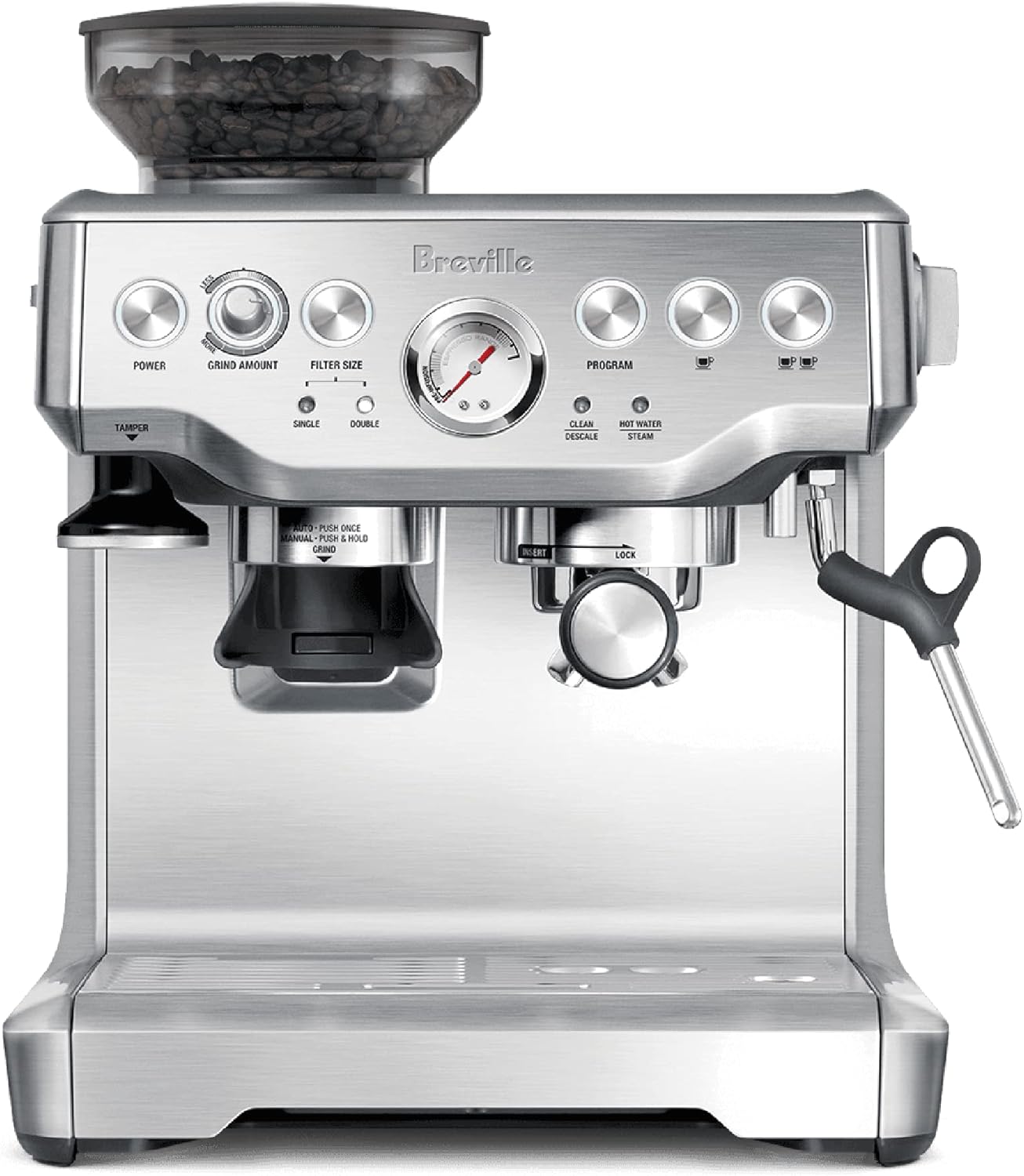
Breville · 54mm · Built-in grinder (Mid-range)
Mid-rangeSemi-automaticBuilt-in grinder
4.5(2,400+ ratings)4.5 out of 5 stars on Amazon
Our score 9.1/10
Best for: Someone buying their first proper machine who does not want to buy a separate grinder
This is the default recommendation for a reason. The conical burr grinder is built in and grinds straight into the portafilter, so you get fresh dosed grounds without spending another $250 on a standalone grinder. Low-pressure pre-infusion, a usable manual steam wand and a genuinely deep pool of tutorials and spare parts mean you can learn on it for years rather than outgrowing it in a season.
Pros
Built-in conical burr grinder with dose and grind-size control
Low-pressure pre-infusion helps the shot start evenly
Huge community, tutorials and cheap spare parts
Steam wand is strong enough to learn real microfoam
Cons
Thermocoil heating is less temperature-stable than a PID machine
54mm baskets have fewer aftermarket options than 58mm
Grinder burrs are a wear item over a few years
What owners actually say: The most-recommended starter machine in r/espresso, with one consistent caveat: the thermocoil is not a PID, so shot-to-shot temperature wanders a little, and the built-in grinder is good rather than great. Plenty of owners eventually add a better standalone grinder and keep the machine.
Ready to look at the Breville? Prices move weekly on Amazon.
Why it wins: Same all-in-one idea as the Express but with ThermoJet heating, so it is ready in seconds instead of minutes.
Breville · 54mm · Built-in grinder (Premium)
PremiumSemi-automaticBuilt-in grinder
4.4(27,000+ ratings)4.4 out of 5 stars on Amazon
Our score 9.0/10
Best for: Households making several drinks back to back on a weekday morning
The Barista Pro is what you buy when the Express is right but you hate waiting. ThermoJet heating brings it to brew temperature in a few seconds and switches to steam almost as fast, which is the difference between two coffees before work and one. You also get a finer grinder adjustment range and an LCD shot timer, which makes dialling in far less of a guessing game.
Pros
Heats to brew temperature in seconds, and to steam almost as fast
Shot timer and clearer grind adjustment make dialling in easier
Grinds, brews and steams from one footprint
Massive review volume behind its rating
Cons
Noticeably more expensive than the Barista Express
Housing uses more plastic than the price implies
Still 54mm, so accessory choice is narrower than 58mm
What owners actually say: Owners consistently say the fast heat-up is the feature that changes daily use. The common complaints are that the plastic-heavy housing feels less solid than the price suggests, and that steam power, while quick, is a little softer than the Express for big milk volumes.
Ready to look at the Breville? Prices move weekly on Amazon.
Why it wins: A commercial 58mm group and a brass boiler at the lowest price anyone sells them for.
Gaggia · 58mm commercial · No grinder (Mid-range)
Mid-rangeSemi-automaticNo grinder
4.4(200+ ratings)4.4 out of 5 stars on Amazon
Our score 8.8/10
Best for: Anyone who wants the upgrade path enthusiasts use, and is happy to buy a grinder
The Evo Pro is the cheapest machine here that uses a full 58mm commercial group and a brass boiler, which is why it never really goes out of fashion. Every basket, tamper, bottomless portafilter and puck screen on the market fits it, it is built to be opened and serviced, and the steam wand is a proper commercial-style one rather than a panarello frother. It is also the least forgiving machine on the list — there is no automation hiding a bad grind.
Pros
Full 58mm commercial group — every accessory fits
Brass boiler and serviceable, mod-friendly build
Commercial-style steam wand with real steam power
Holds value and lasts a decade with basic care
Cons
No grinder included, and it needs a good one
No PID from the factory — temperature surfing or a mod
Steepest learning curve on this list
What owners actually say: The classic r/espresso answer for people who want to actually learn. The two things owners always mention: you need a real grinder for it to make sense, and temperature surfing is part of life unless you add a PID kit, which is a very common mod.
Ready to look at the Gaggia? Prices move weekly on Amazon.
Best for: Households that want good coffee daily without espresso becoming a hobby
This is the machine to buy if the goal is coffee, not craft. Beans go in the hopper, you press a button, and it grinds, tamps, brews and froths milk without you touching a portafilter. The trade-off is control: you adjust strength, volume and grind coarseness rather than dose and pressure, so the ceiling is lower than a semi-automatic in skilled hands — but the floor is far, far higher for everyone else.
Pros
One-touch espresso and milk drinks with no technique required
Grinder is built in, so there is no second purchase
Very consistent from cup to cup and person to person
Removable brew unit and milk parts make cleaning straightforward
Cons
Less control than a semi-automatic, so a lower quality ceiling
More internal parts that can eventually need service
Grinding and brewing cycle is noisy
What owners actually say: Espresso forums rank super-automatics below manual machines on outright shot quality and say so bluntly, but the same threads are full of people who moved to one and drink more good coffee than they did before. The recurring practical note is that the internal brew unit and milk system need regular rinsing or the drinks start tasting stale.
Ready to look at the De'Longhi? Prices move weekly on Amazon.
Why it wins: Commercial-grade components and a steam wand that behaves like a café machine, in a box people keep for a decade.
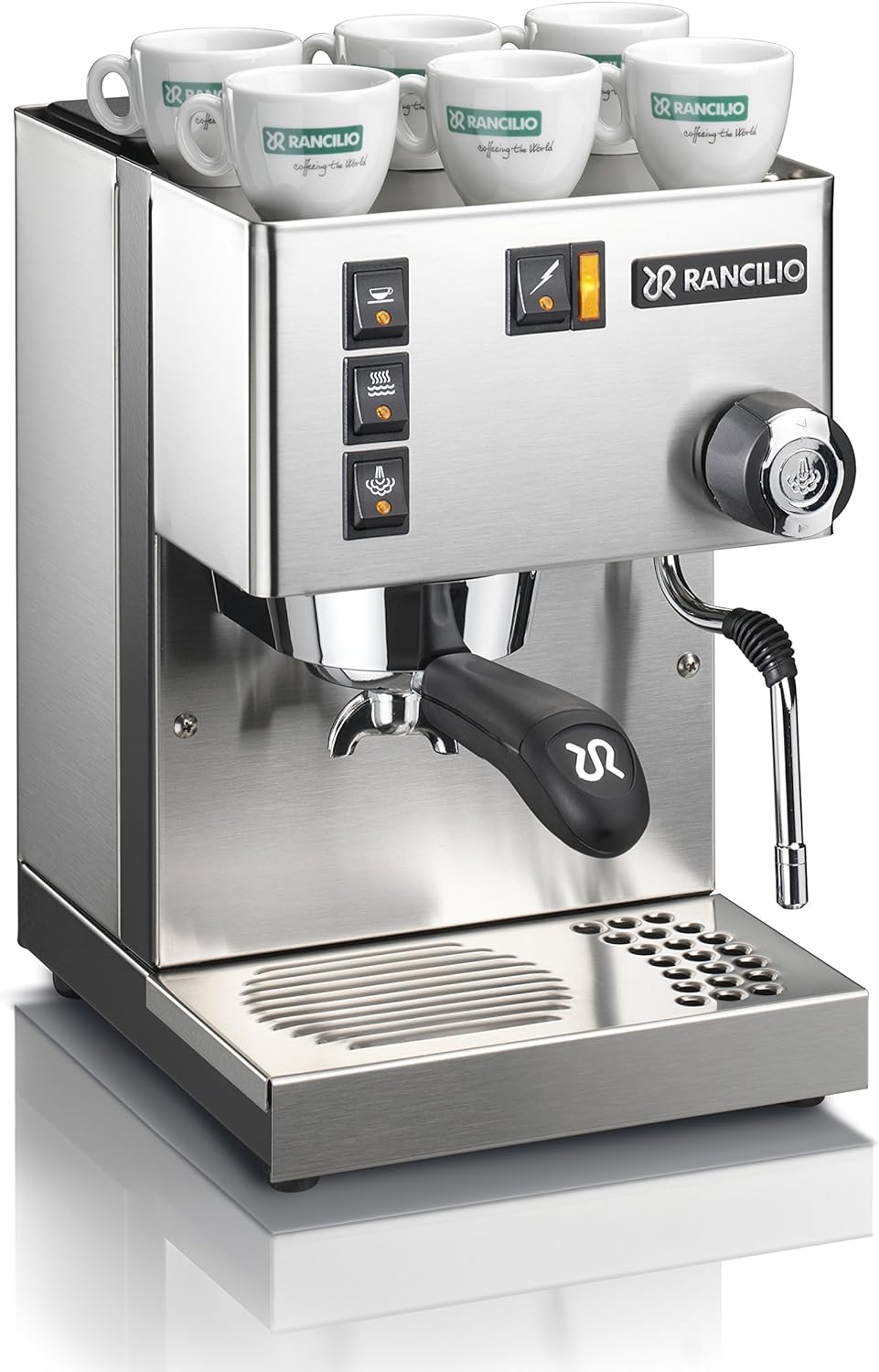
Rancilio · 58mm commercial · No grinder (Premium)
PremiumSemi-automaticNo grinder
4.3(3,100+ ratings)4.3 out of 5 stars on Amazon
Our score 8.5/10
Best for: Enthusiasts building a long-term setup around a separate grinder
The Silvia is the machine people buy last. It is stainless and brass rather than plastic, the 58mm group and portafilter are the same parts a café uses, and the steam wand puts out enough dry steam to texture milk properly instead of just heating it. It is a single boiler, so you brew and then steam rather than doing both at once, and there is no grinder in the box — this is a component in a setup, not an appliance.
Pros
Commercial 58mm group and brass boiler built to be serviced
Steam power well beyond anything else at this price
Parts and community support going back many years
Holds resale value unusually well
Cons
No grinder, no PID and no pre-infusion as standard
Single boiler means brewing and steaming are separate steps
Heavy, and needs the most technique of anything here
What owners actually say: A long-running favourite for people who want something repairable rather than replaceable. Two honest gripes come up every time: temperature surfing is required unless you fit or buy a PID version, and single-boiler workflow feels slow if you are making several milk drinks in a row.
Ready to look at the Rancilio? Prices move weekly on Amazon.
Why it wins: Under six inches wide, heats in seconds, and costs a fraction of everything else on this page.
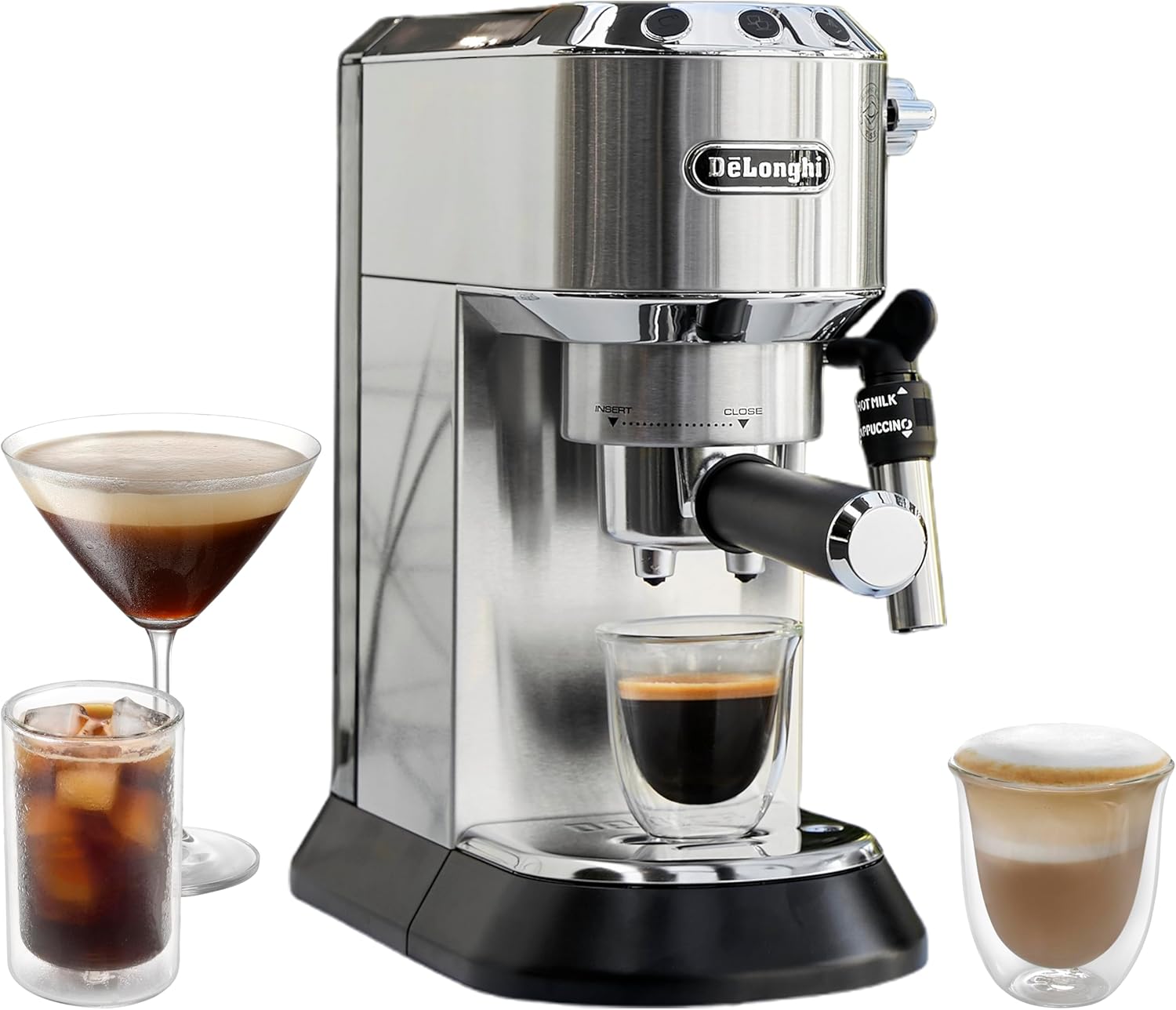
De'Longhi · 51mm De'Longhi · No grinder (Budget)
BudgetSemi-automaticNo grinder
4.3(4,800+ ratings)4.3 out of 5 stars on Amazon
Our score 8.3/10
Best for: Small kitchens, apartments and anyone testing whether they actually want this hobby
The Dedica is remarkable mostly for its footprint — under six inches wide, so it fits where nothing else does. The thermoblock heats in seconds, the slim steam wand is better than it looks for the money, and it makes a genuinely decent milk drink. The limits are real: a small 1.1L tank, a proprietary 51mm portafilter with limited accessories, and pressurised baskets that flatter mediocre grounds rather than reward good ones.
Pros
Under six inches wide — fits kitchens nothing else fits
Thermoblock heats in seconds from cold
Very low entry price for a real pump machine
Steam wand is capable enough for flat whites and lattes
Cons
Small 1.1L tank needs frequent refilling
Proprietary 51mm portafilter limits accessories
Pressurised baskets cap how good the shot can get
What owners actually say: The standard recommendation for tiny kitchens and tight budgets. Owners like it far more than enthusiasts expect them to; the two repeat complaints are refilling the small tank constantly and the non-standard 51mm size limiting basket and accessory upgrades later.
Ready to look at the De'Longhi? Prices move weekly on Amazon.
Pressure, tank and footprint figures are manufacturer-stated. Remember that a 15-bar pump rating is the pump's maximum, not the pressure at the coffee puck — every machine here brews at roughly nine bars. Tap a card to check current pricing on Amazon.
Our score isn't the Amazon star rating. Stars measure how happy buyers were on the day they reviewed — often marked down for price, a failed delivery or a fiddly first setup. Our score weighs use-case fit, features you get without ongoing hassle, long-term reliability and value. That's why a 4.3-star product can still be a sensible buy, and why a cheap machine with a high rating doesn't automatically top the list.
Sales rank first
We started from the Amazon US best sellers for home espresso machines, not from press releases. Every pick is something people are actually buying, using daily and reviewing.
Nothing under 4.0 stars
Anything rated below 4.0 on Amazon was cut regardless of how good the spec sheet looked. Espresso machines live or die on reliability, and a low rating in this category almost always means leaks, pumps or scale failures.
Both types represented
"Best espresso machine" means two different products depending on whether you want to learn or just want coffee. The list deliberately covers semi-automatics and a super-automatic, so you can see honestly what each approach costs you.
Owner threads
We read the long-term threads — temperature surfing, scale damage, plastic housings, grinder regret and how quickly a machine stops getting used — and those went straight into the cons.
Semi-automatic vs super-automatic: the decision that matters
Forget bar pressure for a minute. The one choice that decides whether you still use this machine in six months is how much of the work you want to do. A semi-automatic hands you the grind, the dose and the shot; a super-automatic hands you a button. The first has a much higher ceiling. The second has a much higher floor — and a machine nobody in the house can be bothered to use makes zero good coffee.
The machine is rarely the whole bill. Beans, water treatment, cleaning chemicals and — on machines without one built in — a grinder are the real ongoing cost. Typical US ranges:
Beans — $200 to $600/year
A double shot uses roughly 18g, so a daily drinker gets through about 7kg a year. Supermarket beans sit at the bottom of that range; fresh specialty roasts at the top, and they make a bigger difference than most hardware upgrades.
A grinder — $0 to $400 up front
Zero if your machine has one built in. If it doesn't, this is not optional — a decent entry burr grinder starts around $150 and it will affect your coffee more than the machine itself.
Descaler — $15 to $40/year
Two to four descaling cycles a year depending on water hardness. Skipping it is the most expensive saving in this hobby, because scale kills boilers and pumps.
Water filtration — $20 to $80/year
Filter cartridges or bottled low-mineral water. Cheaper than descaling constantly, and it noticeably improves how the coffee tastes as a side effect.
Backflush detergent — $10 to $20/year
A tub of espresso machine cleaner lasts most people a year or more. Only applies to machines with a three-way valve, but it keeps the group and shower screen from turning rancid.
Gaskets and screens — $10 to $30/year
Group gaskets harden and start leaking after a year or two of daily use, and shower screens clog. Both are cheap parts and easy jobs on 58mm machines.
Realistic totals
A daily two-drink habit lands around $300–$500 a year in beans and upkeep for a machine with a built-in grinder. Even at the top of that range it undercuts a café habit heavily — the machine is usually the cheap part.
Semi-automatic or super-automatic — which should I buy?
It comes down to whether you want a hobby or a habit. A semi-automatic gives you control over grind, dose and shot time, which is how you get a genuinely great espresso, but it asks for a few minutes and some practice every morning. A super-automatic grinds, brews and froths at one button press with almost no skill required and a lower quality ceiling. If nobody in the house wants to learn, the button wins every time.
Do I really need a separate grinder?
If the machine does not have one built in, yes — and it matters more than the machine. Espresso needs a fine, consistent, adjustable grind that blade grinders and pre-ground supermarket coffee cannot deliver. A common rule of thumb in owner threads is to spend roughly as much on the grinder as on the machine, which is exactly why all-in-one models with a built-in burr grinder are so popular for a first purchase.
What is the difference between 51mm, 54mm and 58mm portafilters?
58mm is the commercial standard, so baskets, tampers, bottomless portafilters and puck screens are widely available and interchangeable. 54mm is Breville's size and has a decent but smaller accessory market. 51mm is largely proprietary and the most limited. Size does not decide shot quality on its own, but it does decide how much you can upgrade later.
What does PID actually do, and do I need it?
A PID holds brew water within a narrow temperature band instead of letting a thermostat swing above and below the target. That makes shots more repeatable, especially with lighter roasts that are fussy about temperature. Machines without one can still pull excellent coffee — owners either 'temperature surf' by timing the boiler cycle, or fit an aftermarket PID kit, which is one of the most common mods in this category.
Are pressurised baskets a bad thing?
They are a training aid, not a defect. A pressurised basket creates artificial back-pressure so pre-ground or inconsistently ground coffee still produces crema. That makes early results forgiving, but it also hides grind problems and caps how good the shot can get. Most people who stick with the hobby move to single-wall baskets and a better grinder within a year.
How many bars of pressure do I need?
Espresso is extracted at around nine bars. Machines advertise 15 or 20 bar pumps because that is the pump's maximum, not the pressure at the puck — the group and basket regulate it down. A bigger bar number on the box is a marketing figure rather than a quality signal, so it is one of the least useful specs to shop on.
Can I use regular supermarket coffee beans?
You can, and it will work, but freshness does most of the heavy lifting in espresso. Beans that have been sitting on a shelf for months degas poorly and give thin, flat shots regardless of the machine. Beans roasted within the last few weeks, ground immediately before brewing, make a bigger difference than moving up a price bracket.
How long does a home espresso machine take to warm up?
It varies hugely by heating system. Thermoblock and ThermoJet machines are ready in seconds. Traditional boilers technically light up in a couple of minutes but need considerably longer for the group head and portafilter to reach a stable temperature, and pulling a shot too early is one of the most common reasons a new machine seems to make sour coffee.
Single boiler, dual boiler or heat exchanger — does it matter at home?
Mostly it affects speed rather than quality. A single boiler makes you brew and then wait for it to switch to steam temperature, which is fine for one or two drinks and irritating for four. Heat exchangers and dual boilers let you brew and steam at the same time. For most households the single-boiler wait is an acceptable trade for a much lower price.
How much maintenance is involved?
More than a drip machine, less than people fear. Expect a daily backflush or group wipe, weekly basket and shower screen cleaning, a detergent backflush every few weeks on machines with a three-way valve, and descaling on a schedule that depends on your water hardness. Super-automatics add rinsing the milk system and the internal brew unit, which is the step owners most often skip and then regret.
Will hard water damage the machine?
Scale is the single biggest killer of home espresso machines. Hard water leaves deposits in the boiler and lines that restrict flow and eventually cause failures that are not worth repairing. Using filtered or bottled low-mineral water and descaling on schedule is the cheapest life extension available, and it costs far less than a service call.
How much does it cost per cup compared with a café?
Beans are usually the smallest number in the equation. A double shot uses roughly 18 grams, so a bag of specialty beans typically works out somewhere well under a dollar a drink, plus milk. Against café prices the machine tends to pay for itself over a year or two of daily drinking — although most owners find they also start buying nicer beans, which quietly eats the savings.
Do I need a milk frother if I only drink black coffee?
No, and skipping the milk requirement widens your options a lot. If nobody in the house drinks lattes or flat whites, you can ignore steam wand power entirely and put the money towards temperature stability, build quality and a better grinder instead.
How long before I'm pulling shots I actually enjoy?
Faster than most people expect. With a built-in or decent burr grinder, owners typically get a drinkable shot on day one and a genuinely good one within a week or two of dialling in the grind. The learning happens on the machine, not before it, so there is nothing to prepare in advance — every pick here is current, in stock and covered by Amazon returns.