2026 edition · Amazon US best sellers cross-checked
The best home EV chargers, ranked without the fluff
No 2,000-word intro about "the electric revolution." We pulled the top-selling Level 2 chargers on Amazon US, filtered to units above 4.4 stars with real review volume, and cross-checked them against Reddit owner threads, Wirecutter, and Car and Driver testing. Six made the list.
Why it wins: Cheapest genuinely good 48A smart charger.
Emporia · 48A / 11.5 kW (Mid-range)
Mid-rangeJ1772 or NACS48A / 11.5 kW
4.6(12,000+ ratings)4.6 out of 5 stars on Amazon
Our score 9.4/10
Best for: Almost everyone with a 60A circuit to spare
Full 48-amp output, UL listed, Energy Star, hardwired with a whip in the box, and an app that actually shows you kWh and cost per session. Wirecutter and Car and Driver both landed on Emporia as their top pick, and it undercuts ChargePoint and Tesla by $50–$150 while doing the same job.
Pros
Full 48A output at a mid-range price
Load balancing avoids a costly panel upgrade
App tracks kWh, cost and scheduling properly
Both J1772 and NACS versions sold
Cons
Hardwired install means an electrician
Plastic housing, not metal
What owners actually say: The consensus pick in r/evcharging threads: nobody regrets buying it, and the load-balancing option saves people a panel upgrade.
Ready to look at the Emporia? Prices move weekly on Amazon.
Best for: People who want zero apps and zero firmware drama
A cast aluminium brick with no Wi-Fi, no account and nothing to update. Plugs into a NEMA 14-50 outlet, delivers 40A, and survives winters that kill plastic units. If you already schedule charging in your car's app, the smart features on pricier chargers are dead weight.
Pros
Cheapest reliable 40A unit
Metal enclosure, genuinely weatherproof
Plug-in — no hardwiring needed
No app, no cloud, nothing to break
Cons
No scheduling or energy monitoring
Cable is stiff in cold weather
What owners actually say: The classic 'buy it and forget it' recommendation. The running joke is that the only failure mode is losing the key to the padlock hole.
Ready to look at the United Chargers? Prices move weekly on Amazon.
Best for: Tesla households that don't want to buy the official wall connector
A NACS-native wall unit that plugs into a NEMA 14-50 outlet, so a Tesla charges without the J1772 adapter dance. Includes a cable holster and a magnetic plug dock, and the app handles scheduling for off-peak rates. Note Tesla's own Universal Wall Connector isn't sold on Amazon — this is the practical Amazon route to a NACS plug on your wall.
Pros
Native NACS plug — no adapter
Plug-in 14-50, easier install
Cable management and plug dock included
Cheaper than official Tesla hardware
Cons
40A, not 48A
App is basic
Newer brand with less track record
What owners actually say: Owners rate it as the value NACS option; complaints are mostly about the app being basic rather than the hardware.
Ready to look at the EVIQO? Prices move weekly on Amazon.
Why it wins: Deepest utility and time-of-use integration.
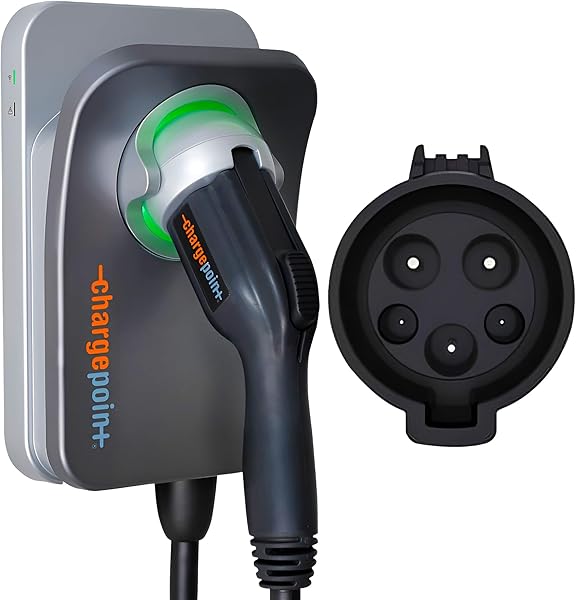
ChargePoint · 50A / 12 kW (Premium)
PremiumJ177250A / 12 kW
4.4(9,000+ ratings)4.4 out of 5 stars on Amazon
Our score 8.7/10
Best for: Time-of-use rate plans and utility rebate programs
The most mature software on this list: amperage is selectable from 16–50A, it links to most utility rebate and demand-response programs, and Alexa/Google control works without fuss. You're paying for that ecosystem — the hardware itself is not faster than Emporia's.
Pros
Selectable 16–50A output
Widely accepted for utility rebates
Mature app with reminders and reporting
Both plug-in and hardwired options
Cons
Priciest non-Tesla pick
Occasional cloud/app outages
Account required for full features
What owners actually say: Praised for rebate eligibility and hated for occasional cloud outages; most people say charging still works locally when the app doesn't.
Ready to look at the ChargePoint? Prices move weekly on Amazon.
Why it wins: Highest sustained output on a 60A circuit.
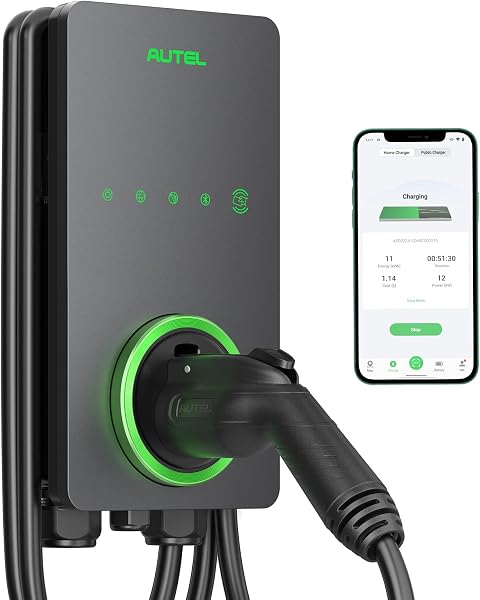
Autel · 50A / 12 kW (Premium)
PremiumJ177250A / 12 kW
4.5(4,000+ ratings)4.5 out of 5 stars on Amazon
Our score 8.6/10
Best for: Big-battery trucks and SUVs that need every overnight kWh
A 50-amp unit with a solid IP65 body, an integrated cable holster and Bluetooth fallback so it keeps charging when Wi-Fi drops. If you're charging an F-150 Lightning or an EV9 from low state of charge nightly, the extra 2A over the 48A units genuinely shortens the session.
Pros
Up to 50A output
Bluetooth control when Wi-Fi drops
Sturdy IP65 housing and holster
Goes on deep discount often
Cons
Heavy, stiff cable
App is less polished than ChargePoint's
What owners actually say: Owners like the local Bluetooth control; the recurring complaint is a heavy, unwieldy cable.
Ready to look at the Autel? Prices move weekly on Amazon.
Best for: Renters, condos, or a backup unit that lives in the frunk
A plug-and-go 240V unit with a 16 ft cable and a NEMA 14-50 plug, so if a dryer-style outlet already exists you get real Level 2 speed with no electrician and nothing bolted to the wall. It also doubles as travel insurance for road trips to campgrounds with random outlets.
Pros
No installation required
Full 40A on a 14-50 outlet
Very high review volume, cheap
Fits in a trunk bag
Cons
Shorter 16 ft cable
No app or scheduling
Nothing to mount it to
What owners actually say: The most-recommended 'I rent, what do I do' answer, and the second charger a lot of people keep in the car.
Ready to look at the Lectron? Prices move weekly on Amazon.
Output figures are manufacturer-stated; real delivered power depends on your circuit and your car's onboard charger. Tap a card to check current pricing on Amazon.
Our score isn't the Amazon star rating. Stars measure how happy buyers were on the day they reviewed — often marked down for price, subscriptions or a fiddly setup. Our score weighs use-case fit, features you get without a monthly plan, long-term reliability and value. That's why a 4.1-star product can still be the better buy, and why a 4.7-star one may not top the list.
Sales rank first
We started from the Amazon US best sellers list for EV charging stations, not from press releases. Every pick here is a unit people are actually buying.
Rating floor
Nothing below 4.4 stars, and nothing with a thin review count. High-volume ratings surface the failure modes that a two-week loaner review never sees.
Independent testing
Picks were cross-checked against Wirecutter and Car and Driver's 2026 hands-on tests so the ranking isn't just a popularity contest.
Owner threads
We read the long-term complaint threads — cloud outages, stiff cables, dead firmware — and those went straight into the cons.
40A vs 48A: which one do you actually need?
This is the question that decides your whole purchase, because amps dictate the circuit, the electrician bill and whether you can plug in or must hardwire. The short version: almost nobody needs 48A, and the people who do usually know why.
Charging speed by amperage
Charger output
Circuit needed
Power delivered
Range added per hour*
Install
16A (Level 1 / trickle)
Standard 120V outlet
1.4 kW
~4 miles
Plug in anywhere
32A
40A breaker
7.7 kW
~25 miles
NEMA 14-50 plug-in
40A
50A breaker
9.6 kW
~30 miles
NEMA 14-50 plug-in
48A
60A breaker
11.5 kW
~36 miles
Hardwired only
*Rough figures for a mid-size EV at roughly 3 miles per kWh. Your car's onboard charger caps the real rate — many EVs top out at 7.7 kW or 9.6 kW no matter what the wall unit can supply.
Buy 40A if…
Your daily driving is under about 120 miles.
Your car's onboard charger is 7.7 kW or 9.6 kW (most EVs).
You want a plug-in unit you can take with you when you move.
You'd rather not pay for a 60A circuit run.
Buy 48A if…
You drive a big-battery truck or SUV and arrive home near empty.
Your car accepts 11.5 kW and you have panel capacity for 60A.
Two EVs share one charger overnight.
You're on a narrow off-peak window and need to finish inside it.
What does it actually cost to install a home EV charger?
The charger is often the cheaper half of the project. Installation is what varies, and it varies mostly by how far your panel is from the parking spot and whether that panel has spare capacity. Typical US ranges reported by owners:
Easy install — $300 to $600
Panel is in the garage, within about 15 feet of the charger, and has a spare double-pole slot. An electrician runs conduit, adds a 50A or 60A breaker, and is done in a few hours.
Typical install — $600 to $1,200
Panel is on the other side of the house or outside. Longer conduit run, possibly through a wall or under a slab, plus a permit and inspection in most jurisdictions.
Panel upgrade — $1,500 to $4,000+
Your service is 100A and already loaded, so the utility work and a new 200A panel come first. This is where load balancing earns its keep — it shares an existing circuit instead.
Existing dryer outlet — $0
If a NEMA 14-50 or 14-30 outlet already exists near the car, a plug-in or portable unit skips the electrician entirely. Get the outlet inspected if it is old.
Permit and inspection — $50 to $250
Most cities require a permit for a new 240V circuit. Skipping it can void your home insurance claim if anything goes wrong, so it is not the corner to cut.
Rebates — often $200 to $1,000 back
Many utilities rebate part of the charger and install if you buy an approved smart unit and enrol in a demand-response program. Check your utility's list before you buy.
Cheapest total path
A plug-in 40A unit on an existing 14-50 outlet is the lowest all-in cost for most households — no electrician, no permit, real Level 2 speed.
For most cars, 40A is fine — a 9.6 kW charger adds roughly 30 miles of range per hour, which covers any normal overnight. Go 48A only if you have a 60A circuit available and a car whose onboard charger can accept 11.5 kW.
Plug-in or hardwired?
Plug-in on a NEMA 14-50 outlet is cheaper, movable and easier to replace. Hardwiring is required above 40A continuous and is slightly more reliable long-term because there's no outlet to overheat.
Are smart features worth it?
Only if you're on a time-of-use rate, want per-session cost tracking, or need load balancing to avoid a panel upgrade. Otherwise your car's own scheduler does the same job and a dumb charger has less to break.
NACS or J1772?
Match your car. Teslas use NACS; most other North American EVs use J1772, though that's shifting. If you have one of each, the dual-connector Tesla Universal Wall Connector saves you from adapter juggling.
Can I just use the charger that came with the car?
You can, and on 120V it adds roughly 4 miles of range per hour — fine if you drive under 30 miles a day. Most included cables also work on a 240V outlet with the right plug, which gets you to Level 2 speeds without buying anything. Plenty of owners never install a wall unit at all.
How long a cable do I need?
Measure from where the unit will mount to your car's port, then add 5 feet of slack for parking either direction. 20 ft covers a single-bay garage; 24–25 ft is the safe default if you ever park outside or nose-in and tail-out. Longer cables are heavier and harder to hang neatly.
Do I need Wi-Fi where the charger is mounted?
Only for smart features. Every unit here charges normally when Wi-Fi drops — you just lose scheduling, energy reporting and utility program participation. If your garage signal is weak, favour a dumb unit or one with Bluetooth fallback rather than fighting a mesh extender.
Is it safe to leave one outdoors?
Yes, if it's rated for it — look for NEMA 4, NEMA 3R or IP65 and check the operating temperature range. The failure point in cold climates is usually the cable stiffening rather than the box, and metal enclosures hold up better than plastic over years of sun.
Does a home charger add resale value?
It helps at sale time in EV-heavy markets, but treat it as a convenience purchase, not an investment. If you're renting or moving within a couple of years, buy a plug-in or portable unit so it leaves with you.
What about load balancing — do I need it?
Load balancing lets a charger throttle itself based on what the rest of the house is drawing, so you can install on an existing circuit without tripping anything. If your panel is full or your service is 100A, it can save you a four-figure panel upgrade — that alone justifies picking a smart unit.
Will charging overnight wreck my battery?
No. Level 2 AC charging is gentle compared with DC fast charging, and modern packs manage heat and state of charge themselves. The one habit worth adopting is setting a daily charge limit around 80% and saving 100% for trip days.