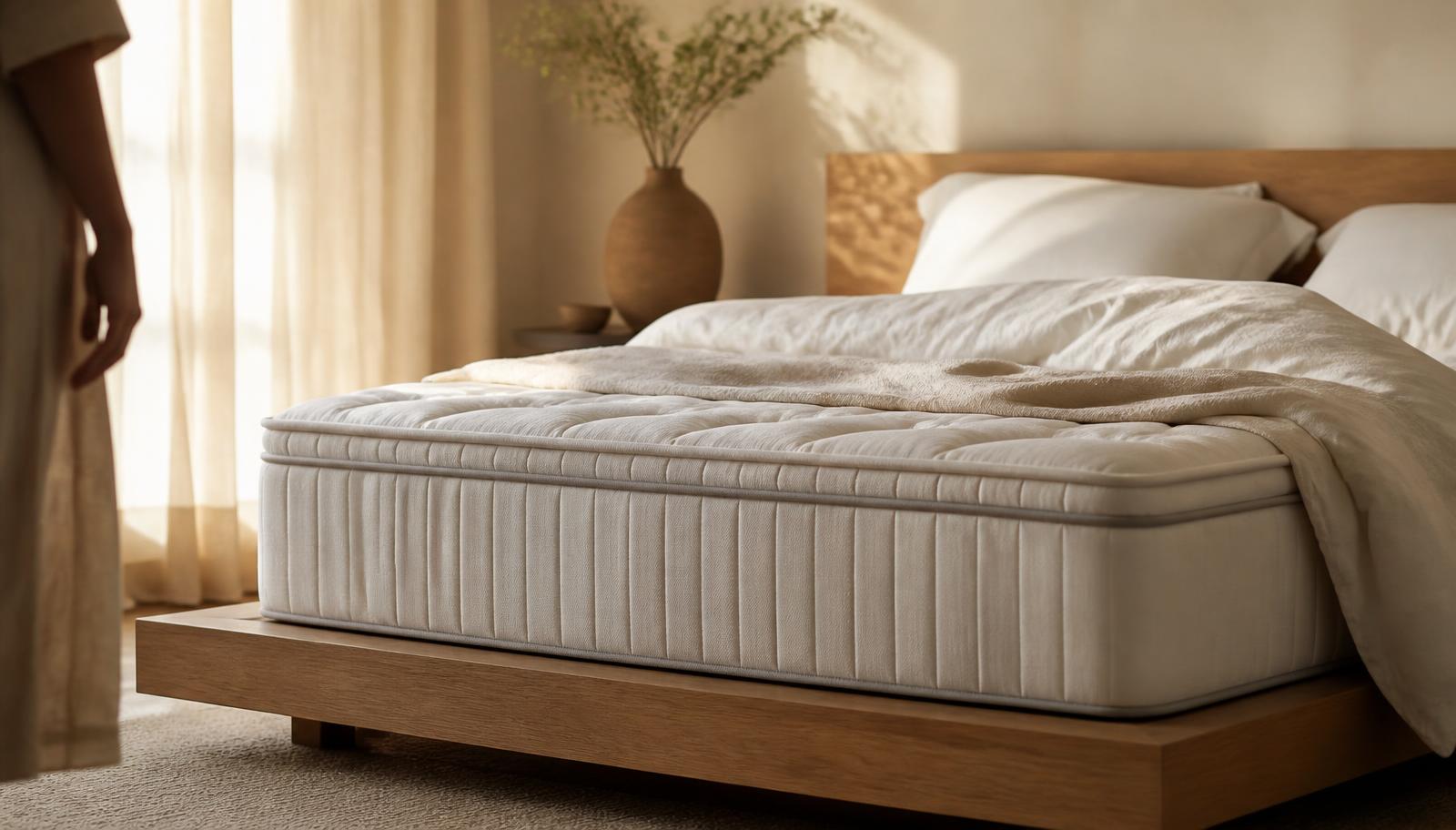
Is a hybrid mattress good for side sleepers?
Yes, provided the top layer is soft enough. A hybrid pairs a foam comfort layer with a pocketed coil core, and that combination suits side sleeping well: the padded surface lets the shoulder settle while the springs push back independently under the hip, which is what keeps the spine in a straight line. What does not work for a side sleeper is a firm hybrid with a thin quilted top — that props the shoulder up and leaves the waist unsupported.
Hybrid or memory foam for side sleeping?
Memory foam contours further, so it is the safer default if your main complaint is shoulder or hip pain. A hybrid is the better choice if you sleep hot, roll between side and back through the night, dislike the sinking feeling of foam, or weigh enough that plush foam lets your hips drop. Every pick on this page is a hybrid for exactly those reasons.
How firm should a hybrid be for a side sleeper?
Medium, or a medium with a pillow top. Side sleeping funnels your body weight through two narrow points, so those points have to sink before the mattress pushes back. Medium firm is the standard recommendation across mattress marketing and it is one step too firm for most dedicated side sleepers — the exception is a heavier sleeper, whose weight compresses a medium-firm bed into feeling like a medium.
Do pocketed coils matter, or is any spring the same?
They matter a lot here. Individually wrapped coils compress on their own, so the coil under your hip can give way while the coils under your waist stay firm. Connected or linked springs move as a sheet, which pulls the whole surface down together and defeats the point for a side sleeper. Every hybrid on this list uses a wrapped or pocketed coil core.
Why does my shoulder hurt when I sleep on my side?
Almost always because the comfort layer above the coils is too thin or too firm for the shoulder joint to drop into. In that position the shoulder is the widest, boniest part of you, so if the surface resists instead of yielding, the joint is compressed all night. The fix is a deeper or softer top layer — which is why the pillow-top picks here rank above the firmer ones.
How thick should a hybrid mattress be?
Twelve inches is the comfortable default for an adult side sleeper, because it leaves real depth above the coils for the shoulder to travel into. Ten inches works well under roughly 230 lb — the top pick is one — and fourteen inches gives the deepest comfort layer here. Above roughly 230 lb, the deeper builds are the safer buy.
Do hybrids sleep cooler than foam?
Noticeably, yes. Air moves through the coil layer instead of sitting in dense foam, so heat has somewhere to go. The comfort layer still matters — a thick untreated foam top will trap warmth on any core — which is why the cooling pick here uses gel-infused foam above the springs rather than plain memory foam.
Are hybrids noisy or do they transfer partner movement?
Some movement transfer is the honest trade-off for coil support: a hybrid will never isolate a restless partner as completely as memory foam. Pocketed coils reduce it a long way compared with old-style innersprings, and none of these are noisy when new, though any spring bed can develop faint noise years in.
Does my body weight change which one I should buy?
More than anything else on the spec sheet. The same mattress feels roughly a firmness level softer to a heavier sleeper and a level firmer to a lighter one. Under about 150 lb, choose a pillow-top pick — a medium-firm hybrid will feel like a floor and your shoulder takes the load. Over about 230 lb, choose the deeper builds or the firmer coil core, because a thin plush top bottoms out.
Do I get a dead arm because of the mattress?
Frequently, yes. A surface too firm for side sleeping compresses the shoulder and the nerves running through it, and pins and needles at 4am is the classic symptom. Owners moving to a softer top layer report it fading within a couple of weeks. If numbness persists on a properly padded mattress, or comes with weakness, raise it with a clinician rather than solving it with bedding.
What pillow height do I need as a side sleeper?
A thicker one than a back sleeper, and the mattress changes the answer. Your pillow has to fill the gap between the mattress and your head, and a plusher top lets your shoulder drop further, which widens that gap. Plenty of people fix a new-mattress neck ache by changing the pillow instead, so budget for one alongside the bed.
Do hybrids need a box spring?
No. All of these are bed-in-a-box designs built for a solid platform, slats spaced under roughly three inches apart, or an adjustable base. What they must not sit on is a sagging box spring or widely spaced slats — the mattress copies the shape underneath it, and that alone undoes the support you paid for.
How long before a new hybrid feels right?
Two to four weeks. It needs 24 to 72 hours to reach full height out of the box, and your body has adapted to the shape of the old bed, so the first few nights can feel wrong even when the mattress is right. Owner reviews are full of people who nearly gave up in week one and were fine by week three.
Will a topper make a firm hybrid work for side sleeping?
If the coil core is sound and the surface is simply too firm, a plush topper is a genuinely good and much cheaper answer, and it is the standard fix for a medium-firm hybrid that is otherwise right. If the mattress sags, a topper cannot help — you are still lying in the dip, just with padding on top.
What if I pick the wrong firmness?
Check which window applies before you order, because it differs. Amazon's standard returns cover the marketplace picks here, and the premium pick carries a 100-night trial. Between those and a plush topper, there is a route back from a mattress that turns out a shade too firm — so there is no reason to sit on the decision.
How often should a mattress be replaced?
Roughly every eight to ten years, and sooner for a budget build under a heavier sleeper. Age is less useful than shape: lay a straight edge across the surface, and if there is a visible dip where your hip lands, the support core has already failed and no bedding will compensate for it.