2026 edition · Amazon US best sellers cross-checked
The best outdoor security cameras, ranked honestly
No filler about "peace of mind." We pulled the top-selling outdoor cameras on Amazon US, filtered to units above 4.2 stars with real review volume, and cross-checked the long-term complaint threads from Reddit and owner forums. Six made the list — outdoor cameras only.
Why it wins: 2K, free local storage, no hub and no subscription.
Tapo · 2K QHD (Mid-range)
Mid-range2K QHDBattery (magnetic mount)
4.3(3,300+ ratings)4.3 out of 5 stars on Amazon
Our score 9.4/10
Best for: Almost everyone who refuses to pay a monthly fee
A 2K battery camera that connects straight to Wi-Fi with no hub, mounts magnetically anywhere on a 360° ball joint, and records locally to a microSD card for free. Person, vehicle, pet and package detection all run on-device, so you get useful alerts without a subscription — which is exactly why it keeps winning shootouts against Ring and Blink.
Pros
Free local recording, no subscription needed
No hub or base station required
Magnetic mount repositions in seconds
On-device person/vehicle/package detection
Cons
Battery needs recharging every few months in busy spots
App is functional but not as slick as Ring's
What owners actually say: The recurring "just buy Tapo" answer in r/homesecurity — people like that alerts and recordings keep working with the cloud switched off entirely.
Ready to look at the Tapo? Prices move weekly on Amazon.
Why it wins: Two-year battery life for the least money.
Blink · 1080p HD (Budget)
Budget1080p HD2× AA lithium (up to 2 years)
4.5(31,000+ ratings)4.5 out of 5 stars on Amazon
Our score 9.0/10
Best for: Covering several spots cheaply inside the Alexa ecosystem
The cheapest camera here that people genuinely keep using. Two AA lithium cells run it for up to two years, setup takes minutes, and a Sync Module 2 plus a USB stick gives you local backup instead of a cloud bill. It is 1080p rather than 2K, and that is the trade you are making.
Pros
Up to two years on AA lithium batteries
Cheapest way to cover multiple angles
Local backup via Sync Module 2 + USB
Tight Alexa and Echo Show integration
Cons
1080p only — plate and face detail is limited
Person detection needs a Blink subscription
Local storage requires buying the Sync Module
What owners actually say: Owners describe it as the set-and-forget option: the batteries really do last, but almost everyone eventually adds the Sync Module so clips are not stuck behind a subscription.
Ready to look at the Blink? Prices move weekly on Amazon.
Why it wins: Bright spotlights plus a 105 dB siren.
Ring · 1080p HD (Mid-range)
Mid-range1080p HDQuick-release battery pack
4.6(19,500+ ratings)4.6 out of 5 stars on Amazon
Our score 8.9/10
Best for: Driveways and side gates where you want to scare people off
The camera to buy if the goal is making someone leave rather than filming them leaving. Dual LED spotlights give real colour night footage, the siren is loud enough to be embarrassing, and two-way talk is the most reliable of any app here. The battery pops out for charging so the camera never comes off the wall.
Pros
Dual spotlights give true colour night video
Built-in 105 dB siren
Swappable battery — no downtime while charging
Best-in-class app, alerts and two-way audio
Cons
No local storage at all — cloud plan or nothing
1080p in a field moving to 2K
Recorded history is paywalled
What owners actually say: The most common upgrade story on r/ringdoorbell: people rate the hardware and the response speed, and grumble that almost nothing useful survives cancelling the Ring Protect plan.
Ready to look at the Ring? Prices move weekly on Amazon.
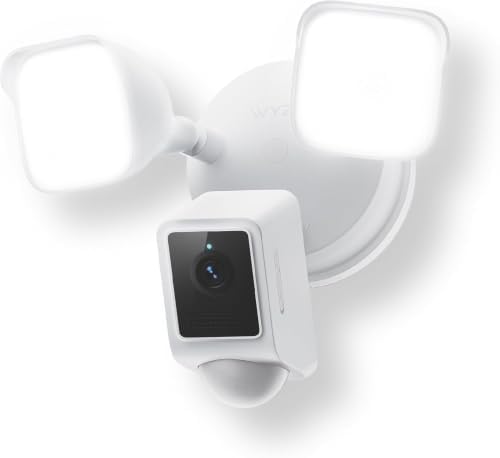
Why it wins: 2,800 lumens and 2K for floodlight-only money.
Wyze · 2K (Budget)
Budget2KHardwired (junction box)
4.5(2,900+ ratings)4.5 out of 5 stars on Amazon
Our score 8.7/10
Best for: Lighting up a driveway or back yard, with the camera as a bonus
Two adjustable 1,400-lumen heads, a 2K camera, a siren and local microSD recording for roughly the price of a plain smart floodlight. It replaces an existing fixture so there is no battery to babysit and no dead zone at 3am. You need a wired junction box, which is the only real gate on buying it.
Pros
2,800 total lumens across two aimable heads
2K video with free microSD recording
Always powered — no charging, no gaps
Built-in siren and motion-triggered light
Cons
Requires a hardwired junction box
Wyze's cloud and app reliability is inconsistent
Colour night video depends on the light firing
What owners actually say: Owners say the lighting is far brighter than they expected for the price; the honest caveat in every thread is that Wyze's app and cloud have had wobbly patches, so use the SD card.
Ready to look at the Wyze? Prices move weekly on Amazon.
Why it wins: Integrated solar panel and full 360° pan/tilt.
eufy · 3K dual-lens (Premium)
Premium3K dual-lensBattery + built-in solar panel
4.2(6,300+ ratings)4.2 out of 5 stars on Amazon
Our score 8.6/10
Best for: A spot with no power and no wish to ever climb a ladder again
A dual-lens 3K camera on a 360° pan and 70° tilt head with a solar panel on top, so a few hours of daylight a day keeps it running indefinitely. Auto-tracking follows people across the yard, the telephoto lens fills in detail, and 8GB of storage is built in with no subscription required.
Pros
Built-in solar — effectively never needs charging
360° pan, 70° tilt with motion auto-tracking
Dual 3K lenses including telephoto detail
8GB local storage, no subscription
Cons
Needs real daily sun to stay topped up
Pan/tilt means moving parts to wear out
Highest price on this list
What owners actually say: The favourite pick for sheds, gates and long driveways with no outlet nearby. Owners in genuinely shaded spots still top it up by cable a couple of times a year.
Ready to look at the eufy? Prices move weekly on Amazon.
Why it wins: True 4K detail with pan/tilt coverage.
Tapo · 4K UHD (Mid-range)
Mid-range4K UHDWired (plug-in)
4.3(800+ ratings)4.3 out of 5 stars on Amazon
Our score 8.5/10
Best for: When you need to actually read a plate or recognise a face
The resolution pick. 8MP 4K means digital zoom still holds detail, and the pan/tilt head sweeps a whole driveway or yard from one mounting point instead of two cameras. It is mains powered, records to microSD for free, and runs AI person, vehicle and pet detection on-device.
Pros
Genuine 4K — usable detail when you zoom
Pan/tilt covers what two fixed cameras would
Free local microSD recording
On-device AI detection, no subscription
Cons
Needs mains power near the mount
Newest model here — smallest review base
4K clips fill a microSD card fast
What owners actually say: Newer and lower-volume than the rest, but early owners consistently say it is the first budget camera where zoomed-in footage is worth handing to police.
Ready to look at the Tapo? Prices move weekly on Amazon.
Resolution and battery figures are manufacturer-stated; real battery life depends on how much traffic the camera sees. Tap a card to check current pricing on Amazon.
Our score isn't the Amazon star rating. Stars measure how happy buyers were on the day they reviewed — often marked down for price, subscriptions or a fiddly setup. Our score weighs use-case fit, features you get without a monthly plan, long-term reliability and value. That's why a 4.1-star product can still be the better buy, and why a 4.7-star one may not top the list.
Sales rank first
We started from the Amazon US best sellers list for outdoor security cameras, not from press releases. Every pick here is a camera people are actually buying and mounting.
Rating floor
Nothing below 4.2 stars, and nothing with a thin review count. High-volume ratings surface the failure modes — dead batteries, missed clips, app outages — that a two-week loaner never sees.
Subscription weighting
Cameras that keep recording and detecting people without a monthly plan were pushed up the list. A $40 camera on a $10/month plan is the most expensive option on this page over three years.
Owner threads
We read the long-term complaint threads — winter battery drop-off, false alerts, cloud outages, cancelled features — and those went straight into the cons.
Wireless vs wired: the decision that matters most
Resolution is what the box shouts about, but power source is what decides whether you still like the camera in a year. Four of the six picks are wireless — battery or solar — and two are wired. It sets where you can mount it, how often you touch it, and whether it records continuously or only in short motion clips.
Camera power source comparison
Power source
Models on this page
Maintenance
Recording style
Where it mounts
Install
Rechargeable battery
Tapo MagCam C425
Recharge every 1–4 months
Motion clips only
Anywhere
Two screws, no wiring
AA lithium (Blink)
Blink Outdoor 4
Swap cells up to every 2 years
Motion clips only
Anywhere
Two screws, no wiring
Battery + solar
eufy SoloCam S340
Effectively none in sunny spots
Motion clips only
Anywhere with daily sun
Two screws, no wiring
Plug-in mains
Tapo C660 4K
None
Continuous or motion
Within cable reach of an outlet
Route a cable
Hardwired / floodlight
Wyze Floodlight v2
None
Continuous or motion
Existing fixture or junction box
Electrical work
Battery estimates are rough: a camera watching a quiet side gate can triple the manufacturer figure, and one facing a busy footpath can halve it. Cold weather reduces battery capacity temporarily on every model here.
Buy wireless (battery or solar) if…
There is no outlet within reach of the spot you want covered.
You rent, or you do not want to drill through a wall.
You mainly want motion alerts, not 24/7 footage.
You might move the camera around as you learn your blind spots.
Buy wired or floodlight if…
You want continuous recording with no motion-triggered gaps.
The camera is high up and you never want to bring it down.
You also want serious light on the driveway.
You already have an outdoor fixture or outlet to reuse.
What outdoor cameras really cost over three years
The camera is the cheap part. Subscriptions, storage and the odd accessory are what decide the real number, and a cheap camera on a monthly plan often ends up dearer than a subscription-free one. Typical US ranges:
Subscription-free path — $0/month
Tapo, Wyze and eufy record to local storage and run person detection on-device. Buy a microSD card once and you are done. Over three years this is the difference between $0 and several hundred dollars.
Single-camera cloud plan — $3 to $5/month
Ring Protect Basic and Blink Basic cover one camera with 30–60 days of clip history. Fine for one camera, but it scales badly the moment you add a second and third.
Whole-home cloud plan — $10 to $20/month
Unlimited cameras plus extras like package alerts and longer history. That is $360 to $720 over three years — usually more than every camera on this page combined.
microSD card — $10 to $30 once
A 128–256GB high-endurance card is the only ongoing storage cost on the local-recording picks. Buy an endurance-rated card; standard cards die from constant rewriting.
Solar panel — $20 to $40 once
Bolts onto most battery cameras and ends charging trips outright in a sunny spot. Cheapest upgrade on this page if ladder trips are what you hate.
Electrician for a floodlight cam — $150 to $400
Only if no outdoor fixture or junction box exists yet. Replacing an existing floodlight is usually a DIY job with the breaker off.
Cheapest total path
A subscription-free camera with a microSD card is the lowest three-year cost for almost every household — no monthly bill, and the footage stays in your house.
It depends on the brand. Tapo, Wyze and eufy record to a microSD card or built-in storage and run person detection on the camera itself, so a plan is optional. Ring stores nothing without a plan, and Blink locks person detection behind one. That single fact should drive your choice more than resolution does.
Is 2K or 4K worth it over 1080p?
For identifying a face or a plate, yes. 1080p across a wide angle gives you 'a person in a dark hoodie'; 2K gives you a usable face at the door and 4K survives digital zoom across a driveway. If the camera is only there to tell you someone is in the yard, 1080p is fine.
How long do the batteries actually last?
It varies a lot. Battery life depends on how many motion events the camera records, how long each clip is, how cold it gets, and how strong the Wi-Fi signal is. A camera watching a quiet corner can go many months; the same camera facing a busy footpath may need charging far sooner. Tightening motion zones and adding a solar panel are the two biggest ways to stretch it.
Will it work in the rain and snow?
Every pick here is IP65 or better, which covers driving rain and snow. Mounting under an eave still helps — not because of water ingress, but because direct rain on the lens ruins the picture and spiders love building webs in front of an exposed IR light.
Do these need Wi-Fi at the mounting point?
Yes, and this is where most installs fail. Stand at the mounting spot with your phone and check you have solid 2.4GHz signal before drilling — outdoor corners are usually the weakest point in a house's coverage. If signal is marginal, move the router, add a mesh node, or use Blink's Sync Module which relays for the cameras.
Can I record 24/7 instead of just motion clips?
Only on mains-powered cameras. Battery cameras sleep and wake on motion, which is what lets the battery last. If you need continuous footage, buy a wired or floodlight camera with a microSD card, or step up to a PoE NVR system.
How many cameras do I actually need?
There is no universal number — it depends on your house size, layout, blind spots, and what you want to watch. A small apartment or townhouse might be fine with one; a larger home or property with multiple entry points may need several. The easiest approach is to start with the spot that worries you most, live with it for a few weeks, and add cameras only where you find real gaps.
How high should I mount them?
High enough to be out of easy reach, but low enough to capture a face rather than the top of a hat. A common starting point is roughly 8–10 feet, angled downward, but the right height depends on your wall, eaves, and the area you want to cover. Aim the camera across the path someone would walk rather than straight at it — cross-frame motion triggers detection faster and gives more useful frames.
Are the false alerts as bad as people say?
Not any more, if you buy a camera with on-device person detection and spend a few minutes drawing activity zones to exclude the road and trees. Cameras relying on plain motion detection will alert you about every cat, shadow and passing car until you narrow the zone.
Can neighbours or police access my footage?
Not without you sharing it. Ring's Neighbors sharing is opt-in and you choose what to upload. If that whole question makes you uncomfortable, a local-storage camera keeps the footage on a card in your house with no cloud copy at all.
Is a camera enough, or do I need an alarm?
Cameras are evidence and deterrence, not prevention. The most cost-effective combination for most homes is bright motion lighting plus one or two visible cameras — light and visibility are what move opportunists along. A monitored alarm is a separate purchase with a separate monthly cost.
Will these work with Alexa, Google or Apple Home?
Alexa works with all six. Google Home works with the Tapo, Wyze and eufy picks but not Blink or Ring. Apple HomeKit support is rare in this price bracket, so if you are committed to the Home app, check the specific model before you buy rather than assuming.